"Art" & "Artist"

Authenticity in art by JW Harrington

Last autumn, I suggested this topic for the January 2026 TCC Art Salon.  I didn’t give any further explication at the time, though what I meant was “What does it mean for a work of art – in any discipline – to be authentic?”

One colleague, who is very concerned about art produced from prompts to AI (artificial intelligence) agents, focused on whether the artist produced the work themselves, versus having asked an AI agent to produce the work from specified parameters. 

Another colleague, a photographer, opined that a photograph’s authenticity hinges on its presentation of what the artist saw, with limited post-shoot modification.

I provided a bit more context:  I often read that really good art is grounded in the creator’s experiences and psyche, and requires the artist to be open to remembering, feeling, and expressing those experiences and psyche.  Is that true, and if so, what does that mean in an artistic process?

A third colleague interpreted this using the phrase “authentic voice.”  He and others went on to elaborate the factors that get in the way of an artist using their authentic voice in their work:

·      thinking about the audience for the work;[1]

·      working on commission for a specific patron;

·      holding back aspects of the self that may be too strong or objectionable to some audiences;

·      repeating a process or theme that you’ve used several times before;

·      knowing exactly what outcome you want.

There’s another part of the claim boldfaced above:  that there is objectively “really good art,” and art that fails to meet that bar.  One artist asked “Who defines ‘good’ or ‘bad’ – shouldn’t it be the viewer?”  She went further – shouldn’t the viewer determine whether the work feels authentic to them?

In a subsequent conversation, a poet friend argued strongly that “good” denotes quality of technique and production, and command of key antecedents of the artist’s work – these are qualities of art that will influence others and stand the test of time.  However, art that isn’t “good” by these standards can still bring joy to the reader or viewer.  Art is indeed a conversation between artist and viewer/listener, and the meaning/import of the conversation depend on both.

If an artist is working quite strictly according to an existing popular (or historic) style, can the work be authentic?  No firm answers to this.  However, participants seemed to agree that when an artist develops their own “style,” they can retain authenticity even when staying within the parameters of that style.

I concluded for myself that authenticity means reflecting the sum total of the artist’s experiences, observations, and emotions – including those that differ from what others might expect from that particular artist.  This yields a certain amount of vulnerability, and a certain amount of originality. 


[1] He went further, suggesting that when you’re contemplating or working on a piece of visual art, the moment you realize that someone else is going to look at it, your process loses some authenticity.  If true, the only way to avoid this is to produce (some) works that you will not let anyone see.
Art is communication by JW Harrington

Art of any discipline is communication:

• from the artist’s background, desires, and image-ination, filtered through

• the medium of words, notes, paint, clay – and the artist’s technical ability, to

• the reader, listener, or viewer – but filtered by their backgrounds, hopes, and knowledge.

Thus, arts of any sort are only completed when read, heard, or viewed. That’s one reason why galleries, museums, concerts, and readings are important: They help complete the communication for which art is produced.

However, the audience’s interpretation is aided by – but doesn’t require -- understanding the artist’s background, desires, and imagery. A poem, dance, composition, or painting must be able to speak for itself. But we usually get more of the communication if we understand the origins of the dance form, the conventions of the musical form, the methods, intent, and symbolism of the visual artist.

At a gallery reception or an artist’s talk, you have the opportunity to learn about artists’ background, desires, and imagery.

So please – in the midst of talking with each other, identify a work that captures you, find the artist, and learn more about their motivations. Take the time to come to an artist talk, or listen to a discussion about producing and presenting paintings, sculptures, plays, poems, novels, music.

What is Black Art? by JW Harrington

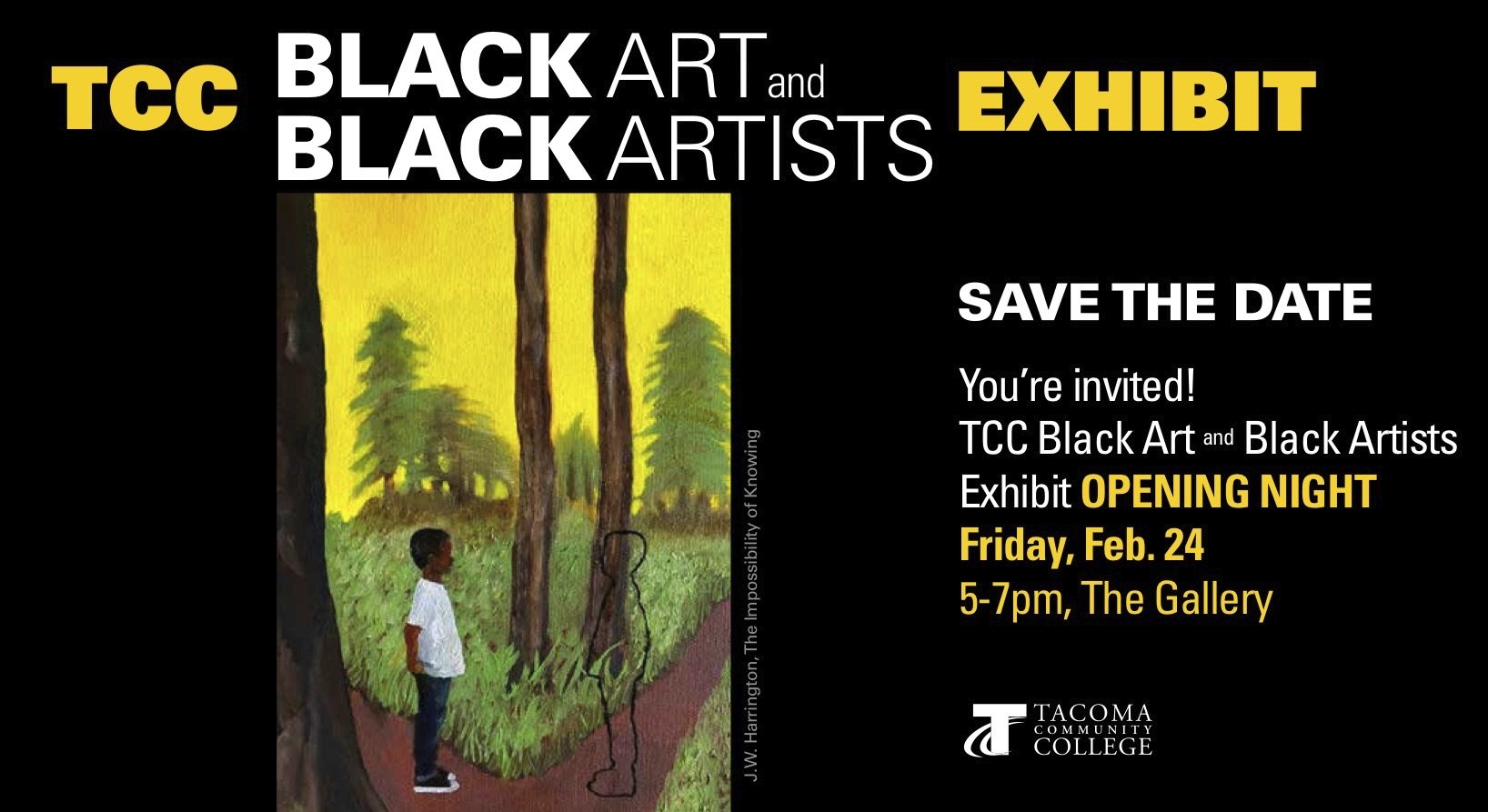
Friday 24 February brought together a tremendous gathering of artists, educators, and civic leaders for the opening of the Black Art and Black Artists exhibit at the Tacoma Community College Gallery. The exhibit runs through 17 March, open M-F, 10-5.

What is “black art”?  I’ve been pondering that, since before I started painting.  My most fundamental answer is “creative work that results from the African diaspora.”  Simple words, but not straightforward. 

                  For a few centuries, and especially in the US since the beginning of the twentieth century, the phrase “black art” in visual arts has implied some kind of social realism, using representation to depict the struggles and successes of Black people.  For me and other abstract artists, this poses a conundrum. 

                  We can easily circumvent the conundrum by declaring black art to be any creative work produced by a member of the African diaspora, whatever the medium and style – orchestral music, abstract poetry, abstract painting or sculpture.  A diaspora is exactly that – a spreading of people across a wide geographic and cultural territory, resulting in a myriad of experiences and expressions.

                  Can a nonblack artist produce “black art”?  Just last week, at the opening reception for the TCC Gallery show, my very thoughtful colleague Travis Johnson declared that the answer is “yes,” if the art reflects the culture and experiences of the African diaspora.  Contemporary white artists produce hip-hop art that reflects African-American-rooted culture.  Many composers and musicians have added to the jazz world of the twentieth century and beyond.  

                  So I’ll return to that fundamental answer I gave above.